I've always adored the manga/manhwa/anime visual style. Critics say it's a knock off of the Japanese visual style, but I don't care. You may have read about my favorite artists of this style before. Do you not recall? I've written other fluff pieces in the past about this stuff! Here are the links:
There's another artbook series series in town, published by Udon Studios. APPLE!
Apparently, the ongoing APPLE anthology, a.k.a. “A Place for People who Love Entertainment”, is an art/comic book in the same vein as the ROBOT artbooks. The point of these pricey tomes is to showcase the talents of the best, and brightest illustrators and graphic artists around Asia (mostly Korea and Japan).
The interesting about APPLE though is that the talent pool will be derived solely from Korea.
Most of the guys (and gals?) involved with this this project are the artists behind some of Korea's most popular Massively Multiplayer Online Role Playing Games.
Seoul Visual Works partnered with Udon to make this dream come true. Founder Eddie Yu has this to say about the project:
“They want to create something more personal and subjective. APPLE is a showcase for those illustrators and their personal creations...
...APPLE isn't a big budget project but the creators are happy to contribute to a worthwhile project, one in which they can see what other artists are up to, learn from them, and study the current trends.”
And don't they look purty? Honestly, despite typing out the distinctions between manga and manhwa months ago, I am unable to really articulate the difference about the two styles. But there is something... judging by these previews. Whereas in the Philippines, wannabe Filipino artists have managed to create a very distinct look with their works (most notably characters having tanner skin tones), I just can't tell, but for some reason, I love these preview shots from the book.
Big.
The only bad thing about these books is that they never come cheap. $35.00 is still a lot of money. Time to break the bank again...
The Koreans have gained notoriety as some of the most skilled illustrators in the world, thanks to their works in video games, artbooks, and even animation. This line of artbooks will only solidify the Koreans grip on the young, unsuspecting artists. Outsourcing is awesome!!! *Sigh*
However, lets look back at the amazing ROBOT series, and see the roots of this project, and what all the fuss is about.
The hook of ROBOT was always to the disturbing mix of really nifty looking anime artwork with the European style of coloring/graphics, coupled with the visual and storytelling abilities of Japanese manga.
I just don't know. In the comic world, (probably more popular in Europe) there is something known as the "painted comics". Painted comics are literally just that, every panel, every frame is painstakingly painted and detailed to such a level that a page looks almost like a work of art. The Blacksad and Hipflask comic series are what comes to mind when I say this.
But when you throw in that style to anime? I don't know, there is that magic in it that makes it look even more dreamlike. Yoshitoshi ABE, one of the regular contributors of ROBOT, manages to pull this off quite well. His series has achieved quite a bit of fame from readers of the books.
Another highlight of the books is the work of Imperial Boy (image above), and how he paints these massive worlds, and crams it with unimaginable detail. And what's crazier is that with one page you would have this view of the overall world. The next page would be a "section" of that world, like a cramped walkway or something. He really wants to capture the feel of a crazy world, and he does it quite well. It's weird, but its great.
The books has a fair amount of the fan service stuff, which is probably why they've got the Mature rating, but hey, if it sells right? It's also got these impossibly cute stuff in it, with some rather disturbing twists (The story involving a bird and a girl is what springs to mind). The only problem I got with ROBOT is its translations can be a little funky, and some of the stories don't make a good deal of sense. Oh well. I'm in it mostly for the art anyway.
Following my post about High Renaissance, you'd think I would post about the Baroque era next... Sorry Void™. Maybe next time, or maybe not at all.
Instead, I'll focus on this one Baroque painter guy. And that would be...
"All works, no matter what or by whom painted, are nothing but bagatelles and childish trifles... unless they are made and painted from life, and there can be nothing... better than to follow nature."
Michelangelo Merisi a.k.a. Caravaggio (1571-1610) was a jerk. Yeah, that's what I hear anyway. But despite having a short fuse, he was one of the greatest, most influential painters of ye' olden days. He never really ran out of commissions to do, and for some odd reason, he always found the time to finish em'.
Judith Beheading Holofernes by Caravaggio, 1599
According to our favorite cheat sheet Wikipedia, Caravaggio's artistic philosophy was greatly influenced during his stay in Milan. His style therefore emphasized 'simplicity and attention to naturalistic detail', as opposed to going all out.
Artchive described his situation quite well, saying that "...Caravaggio aimed to make paintings that depicted the truth, and was critically condemned for being a 'naturalist'. In spite of adverse reactions, Caravaggio was commissioned to produce a number of large-scale paintings. However, certain of these after 1600 were made only to be rejected by patrons on the grounds of indecorum or theological incorrectness."
The Rest During The Fight from Egpyth
See? I told you he was a jerk. Now, all this talk about Naturalism... but what does it mean? Why was it so important, especially following the two eras of the Renaissance? Well, according yet again to the Artchive, everything depended on the "...depiction of the human body, and where the eccentricities of his successors, who did not paint from life at all, distorted the popular notion of what the eye actually sees."
Artchive continues to described it further that "...He painted with an intensity of realism never before equalled, and his impact was so immediate, profound and lasting that it affected all the great painters of the first half of the seventeenth century."
Sleeping Cupid by Caravaggio
Ooooh! This is also a great thing about his life "Caravaggio created himself. He was antinomian, despising all laws of life and art. But his fatal propensity to break all the rules, which turned his life first into anarchy, then tragedy, also made him an artist of astonishing originality and creative power. He destroyed the old order and imposed a new one." Yes. He's got into a lot of arguments and brawls in his life. He got into trial eleven times between 1600 and 1606! He was suspected of sodomy, but got away with it. This was confirmed posthumously. The worse part is that killed a guy during a brawl after a game of tennis, forcing him to be a fugitive for the rest of his life.
Poor shmuck.
The Raising of Lazarus by Caravaggio (Patrick Hunt comments: Lazarus's crosslike pose as an allusion to the "Cross-Bearing Fathers" and some have also long commented on Caravaggio's allusion to Michelangelo's Creation of Adam in the Sistine Chapel with life returning to Lazarus's hand from the command of Christ while the rest of his body is still in the sleep of death...
The contrasting light and darkness on the hand of Lazarus also reminds one of the famous passage in Genesis 1:3when God says "Let there be light". Second, also in parallel with the darkness of Christ's face hidden in like shadow on the left - also suggestive of his yet hidden deity both before and after his Transfiguration."
So what about his work? Oh boy. Despite his rowdy reputation, he really got a lot of s**t done. His "Naturalism" style meant the he painted with such care to detail that in one painting, people could literally identify every individual plants being held by the subject!
Caravaggio was a real sucker for detail, where his philosophy has led some to speculate that where he born born during the "...twentieth or twenty-first century, Caravaggio would have been a photographer or a film maker. But that is nonsense." (Artchive)
Artchive states that "...His fundamental ideas were always absolutely clear, though he continually changed and improved his techniques. He believed in total realism, and he always painted from life, dragging poor people in from the street if need be."
Supper at Emmaeus by Caravaggio, 1598
Caravaggio revolutionized painting in general. I mean this guy, did no preparatory drawings prior to painting his works. He just painted straight onto the canvas, and this method alone earned him some criticism from his peers. Bellori was quoted saying "The painters then in Rome were greatly taken by this novelty, and the young ones particularly gathered around him, praised him as the unique imitator of nature, and looked on his work as miracles."
The Lute Player by Caravaggio, 1595
Artchive sez "..Not a single drawing by him has survived and it is likely that he never did any. He simply stood up to the canvas and painted directly onto it, from the living model."
Death of the Virgin by Caravaggio
His religious art, like I mentioned earlier, received some flack for being "inaccurate", such as the depiction with the Death of the Virgin. The church rejected his works based on how the Virgin looked, when she was either "indecent" or seated, or whatever. What's interesting was how these rejected paintings were still sought after by wealthy Dukes and whatnot.
David with Head of Goliath by Caravaggio
Why are his paintings so dark? Well, that's the secret actually. According to Artchive, "...To achieve realism, he liked to pull his subject out of surrounding darkness into strong lateral or overhead light, as close to the viewer as possible."
Artchive sez "..Caravaggio told the story of Christianity as it had never been told before, as an actual happening"
Crucifixion of Peter by Caravaggio
In the end, his works became objects of debate. His works were a little discomforting. Artchive described how "...The Church, which bought more than half his output, recognised the huge popular appeal of his vivid presentation of the faith. But it sometimes found Caravaggio too real for comfort... What in effect Caravaggio is doing systematically and deliberately, for the first time in the history of art, destroying the space between the event in the painting and the people looking at it. He is giving us direct windows into life, whether religious life or ordinary life."
So woohoo! Woohoo for realism! Woohoo for Caravaggio!
He who loves practice without theory is like the sailor who boards ship without a rudder and compass and never knows where he may cast.
- Leonardo da Vinci
What a way to begin the month. A freakin’ post about a bygone era. Ah well, might as well be researching about this rather than looking for the zillionth science fiction/fantasy artist, right? I jest.
Patron of d’Arts is a series of posts that is aimed to educate me on the very basics of the works of the “Masters”. Y'know, masters like Monet, Van Gogh, Cezanne and all those other guys you heard about while sleeping in art class. I decided to begin this series during the Renaissance, Era of Classicism a time when man was truly in touch with God. Or at least, they sa they were.
Madonna of the Harpies
Some kind of masterpiece / altatpiece made for some nuns
So when did this so called “High Renaissance” era occur? Well folks, it allegedly happened sometime around 1450-1550 or 1500-1530, but one can't be too sure... Oh well. It was, as someone put it, a time when the artist had perfected chiaroscuto (shading) and other techniques, and achieved the photo real. It was said in some book that the best- known artists of the Italian Renaissance grew famous during the High Renaissance. As usual, only the rich and well fed could or would support these artists. I think I mentioned something about the Medici family in my last related post.
A site called “Gutenberg” mentioned the Renaissance as “..the grand consummation of Italian intelligence in many departments—the arrival at maturity of the Christian trained mind tempered by the philosophy of Greece, and the knowledge of the actual world. Fully aroused at last, the Italian intellect became inquisitive, inventive, scientific, skeptical—yes, treacherous, immoral, polluted. It questioned all things, doubted where it pleased, saturated itself with crime, corruption, and sensuality, yet bowed at the shrine of the beautiful and knelt at the altar of Christianity. It is an illustration of the contradictions that may exist when the intellectual, the religious and the moral are brought together, with the intellectual in predominance.
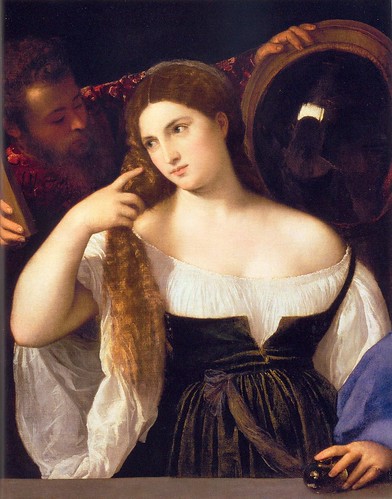
Titian Young Woman Combing Her Hair (1514)
So, basically everyone was hypocrites at the time. So who painted the good stuff? Well, there’s Titian. Yeah, “Titian”. Well, fine, his real name was Tiziano Vecelli or Tiziano Vecellio (1485 – 1576), and he was like this leader of the 16th-century Venetian school of the Italian Renaissance. The man Titian isn’t important though. He’s just good with colors and composition. You can tell how influential these old painters simply by how popular their works are (Duh). Here’s two of his more notable accomplishments:
From Wikipedia: The Rape of Europa (1562) is a bold diagonal composition which was admired and copied by Rubens. In contrast to the clarity of Titian's early works, it is almost baroque in its blurred lines, swirling colors, and vibrant brushstrokes.
And yes, this pic is known as the Venus of Urbino. According to art historians, “the ‘frankness’ of Venus' expression has often been noted, seeing as she stares straight at the viewer, unconcerned with her nudity. In her right hand she holds a posy of flowers whilst her left covers her vulva, provocatively placed in the centre of the composition. In the near background a dog, symbolizing fidelity, is asleep.”
The Gutenberg site also states that “…in his 1880 travelogue A Tramp Abroad, Mark Twain called the this painting "the foulest, the vilest, the obscenest picture the world possesses". He proposed that "it was painted for a bagnio and it was probably refused because it was a trifle too strong', adding humorously that "in truth, it is a trifle too strong for any place but a public art gallery". Funny guy.
Leonardo Da Vinci
Yeah, there was that Da Vinci guy. Leonardo da Vinci allegedly epitomized the renaissance ideal. He’s good, that’s all you needed to know.
From the Gutenberg, who can explain this a lot better than I can: “In 1482, Lorenzo de Medici purchased a lyre which Leonardo had fashioned in the shape of a horse's skull, intending to send it to Ludovico Sforza ofMil an. Leonardo asked to personally deliver the gift, and when he did, Sforza persuaded him to remain in Milan, where he painted his famous mural The Last Supper on the wall of a monastery.
Leonardo da Vinci the Swan or something or another
Leonardo da Vinci took full advantage of having all these wealthy bastards who wanted good art, traveling all over during his career, “..leaving every place he visited awed by his presence... His notebooks, recently published, contain ideas for such inventions as the scaling ladder, rotating bridge, submarine, armored vehicle, and helicopter, none of which were built until decades or centuries later.”
Another Madonna Pic
Leonardo remained in Milan seventeen years, returning to Florence in 1499 when the French invaded Milan. In Florence, he became chief military engineer, a position he held until 1513, when he went to Rome in search of a commission from the pope.
As an aside, I really wanted to buy this Da Vinci hardbound book, but it pisses me off that these books cost more than my basic salary. F**k that!
I used Google to find this image! *Groan*
Pope Leo X preferred the work of the painter Raphael, however, and Leonardo moved on, becoming court painter to Francis I of France, where he remained until his death in 1519. In addition to The Last Supper, Leonardo's best known work is the Mona Lisa, the most famous portrait ever painted. Many of da Vinci's greatest ideas remained just that, and he recorded his plans for future inventions and his notes on life around him in notebooks that have given historians insight into the true extent of his genius.”
Michaelangelo Buonarroti
Whoopee for Michaelangelo. According to Guntenberg yet again, “he enrolled in the school for sculptors established by Lorenzo de Medici in Florence, when he was only thirteen, and soon attracted the attention of Lorenzo himself. Michaelangelo lived for a while in the Medici palace as a member of the family, absorbing the principles of humanism and Neoplatonism that freely flourished there.
Pope Julius II wanted Michaelangelo to create a tomb for him. A grand monument with over forty statue. It took Mike eight months to select the stone. The Pope eventually got impatient and cancelled the project.
Later, Michaelangelo, inspired by the belief that he had a divine calling, traveled to Rome, where, at age 23, he carved the Pieta, a bust of the Virgin Mary, bringing him instant fame. When he returned to Florence in 1501, he was commissioned to sculpt the Hebrew King David, just as Donatello had. Michaelangelo's David became the symbol of Florence's prospering artists, and remains there today.
The Sistine Chapel?
I always dreamed of taking a tour around Europe. Oh well. I guess I should just make plans to visit this recreation in the game Second Life.
Second Life Sistine
In 1508, Michaelangelo began his work decorating the walls and ceiling of the Sistine Chapel in Rome. The project was arduous and time-consuming, and when he finished he had painted over 300 human figures. The painting of the ceiling has assumed legendary status and is considered one of the great artistic undertakings of all time.”
Raphael
Now here’s Raphael, born Raffaello Santi. I typed this guy’s name on google, and that Raffaello name kept popping up. Now I know. Thank you, ignorance! Anyway, like what Gutenberg said, “Raff was the leading painter of the Renaissance. In 1508, Pope Julius II summoned him to Rome to decorate the papal apartments in the Vatican. The most widely known of the series of murals and frescoes he painted is the School of Athens, which depicts an imaginary assembly of famous philosophers.
Raphael - purest of all classical works, possessing serenity/harmony even when representing rigorous action
The Harmonist of the Renaissance is his title. And this harmony extended to a blending of thought, form, and expression, heightening or modifying every element until they ran together with such rhythm that it could not be seen where one left off and another began. He was the very opposite of Michael Angelo.
Raphael maintained the favor of the Julius II and his successor Leo X, and thus painted for papal commissions all his life. He was widely renowned as the greatest painter of his age, and considered so important by his contemporaries that when he died at the premature age of 37 he was buried in the Pantheon.”
Finally, we have good ol’ Andrea del Sarto (1486-1531) who was some Florentine pure and simple. He did a lot of madonnas and altar-pieces, and wasn’t religious himself. Gutensberg described this man more as a painter more than a pietist, and was called by his townsmen "the faultless painter." So he was as regards the technical features of his art.
He was the best brushman and colorist of the Florentine school.
Gutenberg sez’ “He was influenced by other painters to some extent. Masaccio, Ghirlandajo, and Michaelangelo were his models in drawing; Leonardo and Bartolommeo in contours; while in warmth of color, brush-work, atmospheric and landscape effects he was quite by himself. He had a large number of pupils and followers, but most of them deserted him later on to follow Michelangelo.” Yeah. That sucks.
So that' High Renaissance for ya'. It's badly research, woefully incomplete, but that's because you have to pay forty bucks for all the good essays. Will Baroque be next?
It's a beautiful thing to see a great talent such as Scott Robertson give back to the community by selling his secrets to the masses. Forget the fact that Mr. Robertson's DVDs charges USD 60.00 for his video workshops, at least the man is GIVING BACK. A man's still gotta make a livin'.
Who is Scott Robertson? Ah, some of you may searched this fellow, or seen his DVDs, or read his interviews, so I'm not talking to you - I'm talking to the handful that read this blog and have never heard of the chap. First of all, Scott's a designer - He's always been fascinated by speed as a child, learning all about soapbox cars and playing around with lil' toy cars and whatnot.
As a concept designer, he mentioned that the highlight of his career was designing funny looking bikes. He did a bunch of other stuff like design various medical and sporting goods. The guy eventually was hired by a multitude of who's who in the media industry. He also got work in Hollywood as a designer for Minority Report.
In 2002, he founded his own company, Design Studio Press, where the guy disseminated his knowledge about concept designing books to the "masses". He also teamed up with "Gnomon Workshop" to make "how-to" DVDs, an co-coproduced a heckuva lot more, one even featuriing Syd Mead.
What motivates this man? Besides this being his bread and butter, of course. According to 'Advanced Photoshop' magazine, Mr. Robertson said... "Seeing my imagination and the thrill of seeing my designs realized in another form instead of remaining in two dimensions."
"I seem to be a bit of a big pictures kinda guy, I like the concept of the idea more than working out all the details."
The guy is a speed demon. Not only does he love fast cars, the guy can render s**t fast on Photoshop. Industrial design rendering to be exact. And damnit, a lot of this guy's stuff really does approach photo-realism. Or hyper. Whatever. Thanks to his experience in working in games and Hollywood, he's got the skills to conjure up things as fully realized concept that can translate to three dimensional objects. Not everybody can do that!! He also loves working on abstract stuff as they are allegedly the most fun to work on digitally.
Siggraph interviewed Mr. Robertson, and asked him whether digital painting had any exclusive quality to it, compared to traditional medium, and how the exploration of this medium is carried out:
"Yes. There is a group of guys doing pretty fun stuff with custom brushes. Sparth, aka Nicolas Bouvier, has been doing some very cool stuff along with David Levy from Ubisoft out of Montréal. There is a great collective of artists up there. They have been experimenting with a lot of custom brush sets. Here a brush will be 2000 pixels wide and be an entire building or a mountain range. I think these guys are pushing the envelope as far as the speed that conceptual paintings are done."
"They did he use the “happy accident” abstract techniques but now will have specific brush sets that can be as a whole crowd of people or they have a set of trees as brushes. They're maximizing what the digital tool can do as far as providing speed. By playing with a lot of the brush attributes, making them more random and adding some variability to the stroke, they are creating some very amazing paintings in a short amount of time. They may not be finished paintings but they're great starts. They may use “happy accidents,” but they are purposely shifted towards certain architecture or types of landscapes. That's probably the most exciting thing as seen in the past year."
Siggraph also asked Mr. Robertson, the pitalls of the digital revolution in art:
"Probably the thing that jumps out at me the most is if a student doesn’t have good foundation skills. When they try to fix a ‘happy accident’ painting or if they have a good start, they may have an interesting color palette, usually overcomplicated composition. To then pull it off as a finished painting means that they would have to go and redefine the horizon line, redefine some vanishing points, and tighten it up. I think that’s where a lot of the paintings fall apart."
"So, if someone is grounded and has strong drawing skills, they can take one of these loose paintings and fix it, tighten it up, and make it something believable. Structures are more solid because they would be lit properly. It becomes evident when someone’s foundation skills are not strong enough to support this other way of starting a painting."
So there you have it, the concept/industrial designer with a benevolent streak. This is one of the good ones, and if you're starting out in this overcrowded, extremely competitive industry, pick up one of Mr. Robertson's USD 60.00 DVDs, and get ahead in life!
Do you go home, feeling frustrated, and feel this... necessity to fill the Void™ through art. Doing everything you can for the sake of expressing and communicating your darkest, most intimate thoughts? That could very well be the 'purpose' some artists have in choosing art as a hobby/passion. But what are the other reasons that compels people to create art (Aside from mortality)? What drives a person to do these things we in society have identified as creative outlets??!
I recently stumbled across this lil' video, and I gotta say its a bit of an eye-opener. Check it out:
This is "Purpose", my DVD "D.I.Y. OR DIE: Burn This DVD" (The DVD release of "D.I.Y. OR DIE: How To Survive as an Independent Artist")
"This film is a celebration of the artistic underdog! FEATURING interviews and performances from:
Lydia Lunch, Ian MacKaye (Fugazi), J Mascis (Dinosaur jr.), Jim Rose (Jim Rose Sideshow), J.G.Thirlwell (Foetus), Mike Watt (Minutemen), Richard Kern (Filmmaker), Ron Asheton (Stooges), Madigan Shive (Bonfire Madigan), Dave Brockie (Gwar) and more."
Director: Michael W. Dean Edited by: Miles Montalbano
My thoughts: Fascinating? Some might say the insight brought by this video is really good, and some might say... hmm. It all depends. Only recently have I been interested in seeing what or how other artists think - their thought process in the honing of their craft, be it in music, art or film. This film highlights the so-called 'underdogs' of the artistic community. The people who have gone through a lot to bring their unique craft to a niche audience, and there is something really inspiring just hearing these people talk about their experiences, rejections, and minor victories.
I highly recommend (after watching the first two videos which are kind of a pre-req to get into this) to watch Dealing with Adversity and Giving Back. I won't post all the chapters (which are on Youtube as a viral kinda thing) but I'll show what I feel is sort of helpful. It's painful, its profound - try it!
No matter what you do, whether it be painting characters or drawing crap, a familiar style - your style - always seems to surface. C'mon, name me your favorite artist and you'll definitely like a particular feature of his or her art - whether it be the way the artist renders characters, or the color style (fine art style or pastel or comic-book style) or any of that good stuff.
Every contemporary digital artist seems to have their own take on the whole Space Marine thing
If you've drawn say uuh... fan art, like I have been for a while, you can see my uniquely odd style of drawing on my old works. It's just there. So well, why do I bring this topic up? I found this topic on Conceptart.org. I wanted to talk about it, you know - how does a person's style emerge? Roosketch began the topic, and he sounded kinda pissed off:
How did your style come... did you just draw and draw and eventually it appeared? Did you draw something one day, notice one part you liked about it and tried that in the rest of your drawings or has it been there from the start?
I'm looking to become an illustrator and so I'm drawing as much as I can. It's not a lot really, but it's frustrating when I draw something, take a moment to look at it and end up thinking this looks like someone else could've drawn it... It's the quirky things that make a piece memorable I find... just as with photography, you have to play with light and depth of field so you get strange light effects or blurry bits as well as focused bits because otherwise it's just recording what the eye can see anyway!
filterpunk
This may not carry much weight, since i'm still very much an amateur, but i've noticed that some degree of style is just natural. Have 2, 5, 10, any amount of people draw something and i'd put money down that they'll all be different. As much as improving and evolving as an artist is technical , observation and perception lend just as much to the work we produce. Isn't style just the sum of our experiences and observations as artists?
May be there are other ways, these are the ways I can think of to develop a drawing style:
1. copy and learn from a favourite artist
2. learn from a number of artists and combine those attributes which you think work best
3. learn the basic skills and develop a style from one's own preferences
I think each way has its pros and cons.
Caravaggio pretty much was known for a particular style of painting, which a lot of other folks copied off
__J_
May be everyone has some natural style which if developed will look different from everyone else (may be not a big diff, just a bit diff). The reason why it is so hard to develop a personal style is because the natural preference is somewhat not strong enough. When one copy or learn from the same artist work for a long time, some day one's own preferences will be replaced by that artist's preferences.
Seedling
For an individual artist, style, at its best, is what happens when you push your skills as far as they can go. If you try to impose a style onto your art, it will prevent you from pushing your skills to the max. So don't fret over style. Just make art to the best of your ability, and style will happen.
Kawakaze
i have found that style comes from what i am inspired from or doing a lot of. i would not be so worried about developing a style, just look for inspiration and what catches your eye, then try it yourself. naturally what works will stay with you. currently i seem to be big on vectors and fat contour lines, particularly from a lot of the work i do which revolves around cartoons etc etc. i think style has become a problem for me, trying to break out of it is the real challenge. im really into architecture and simple shapes lines these days, its starting to show through in some of the stuff i do.
most importantly surround yourself with variety. take the good parts of everything. style will find its way through and start to shine once u becoem comfortable in doing what you do.
Anime and its art style has been widely criticized in forcing artist to draw a very specific way, not allowing much growth in developing his or her style - naturally, this point of view has been met with some opposition
Kuraudo
I think style always comes from somewhere else, inspiration from someone else. Nothing comes from nothing. Look at some of your favorite artist's work, try to combine some of them. I always like Tetsuya Nomura's style(FFVII, VIII,X, and Kingdom Hearts), have been doing it since 1997 when FFVII came out. And, now that I've seen Marko's and Wesley's style, i try to incorporate all of them to form something i think fits me.
Erwin Madrid's lush painting style really shows off his interesting style Erwin Madrid's Portfolio
JQP
I mean, whew! How the hell do you quantify style? That's a question for the folks who've been studying and practicing art for a lifetime, phd type question. And then the answer they give would probably be incomprehensible to many.
A thought occurs, there are many different layers of style. You know, your style in drawing faces, style in drawing architecture, style in painting either, etc.
That just leads back to the inevitable question, what IS style? Is it something quantifiable, like "an artist's divergence from realism (i.e., "photorealism")" Or is it something more subjective like, "whatever is most uniquely recognizable about an artist's work - i.e., whatever it is that makes his work unmistakable, to the extent it exists at all"
Go crazy thinking about that stuff.
I think a lot of it might come down to what the artist, consciously or not, admires in what he perceives in the world (including within himself) - that will tend to come out in his work.
I know this much, I agree with Seedling that style will happen; it might be problematic to start forcing the issue.
I suppose a lot of 'serious' people despise anime, but you have to admit, ever since its popularity skyrocketed in the Western world, a lot of artists, such as Mark Brunet, have take it, and sorta made it his own, and for that I'm grateful BlueFley/Mark Brunet's Portfolio
__J_ Some clarifications:
1. Way 3 I mentioned above:"learn the basic skills and develop a style from one's own preferences"
normally doesn't mean one can really develop everything, still needs to find inspirations, but may be not as much as Way 2,
2. Way 2 I mentioned above:"learn from a number of artists and combine those attributes which you think work best"
personal preference still comes to play of course but this way is more analytical than Way 3
3. These are just some classifications for ease of discussion, I guess not many people purely do in any of the 3 ways above, just a matter of relative importance
4. Speaking of cons. No way above always work. For way 2, combining different attributes may not look good if this cannot be done seamlessly. For way 3, the resulting style may be one which is not as distinctive as one wants, or may be it's very unique but the market doesn't need, and of course it may also be a great and unique one everyone likes
My thoughts:
Well, that's style for you. Every style (save for anime in most cases) is unique. Just keep drawing, and lets see, shall we?