Following my post about High Renaissance, you'd think I would post about the Baroque era next... Sorry Void™. Maybe next time, or maybe not at all.

Instead, I'll focus on this one Baroque painter guy. And that would be...
Michelangelo Merisi a.k.a. Caravaggio (1571-1610) was a jerk. Yeah, that's what I hear anyway. But despite having a short fuse, he was one of the greatest, most influential painters of ye' olden days. He never really ran out of commissions to do, and for some odd reason, he always found the time to finish em'.

According to our favorite cheat sheet Wikipedia, Caravaggio's artistic philosophy was greatly influenced during his stay in Milan. His style therefore emphasized 'simplicity and attention to naturalistic detail', as opposed to going all out.
Artchive described his situation quite well, saying that "...Caravaggio aimed to make paintings that depicted the truth, and was critically condemned for being a 'naturalist'. In spite of adverse reactions, Caravaggio was commissioned to produce a number of large-scale paintings. However, certain of these after 1600 were made only to be rejected by patrons on the grounds of indecorum or theological incorrectness."
See? I told you he was a jerk. Now, all this talk about Naturalism... but what does it mean? Why was it so important, especially following the two eras of the Renaissance? Well, according yet again to the Artchive, everything depended on the "...depiction of the human body, and where the eccentricities of his successors, who did not paint from life at all, distorted the popular notion of what the eye actually sees."
Artchive continues to described it further that "...He painted with an intensity of realism never before equalled, and his impact was so immediate, profound and lasting that it affected all the great painters of the first half of the seventeenth century."

Ooooh! This is also a great thing about his life "Caravaggio created himself. He was antinomian, despising all laws of life and art. But his fatal propensity to break all the rules, which turned his life first into anarchy, then tragedy, also made him an artist of astonishing originality and creative power. He destroyed the old order and imposed a new one." Yes. He's got into a lot of arguments and brawls in his life. He got into trial eleven times between 1600 and 1606! He was suspected of sodomy, but got away with it. This was confirmed posthumously. The worse part is that killed a guy during a brawl after a game of tennis, forcing him to be a fugitive for the rest of his life.
Poor shmuck.

(Patrick Hunt comments: Lazarus's crosslike pose as an allusion to the "Cross-Bearing Fathers" and some have also long commented on Caravaggio's allusion to Michelangelo's Creation of Adam in the Sistine Chapel with life returning to Lazarus's hand from the command of Christ while the rest of his body is still in the sleep of death...
The contrasting light and darkness on the hand of Lazarus also reminds one of the famous passage in Genesis 1:3 when God says "Let there be light". Second, also in parallel with the darkness of Christ's face hidden in like shadow on the left - also suggestive of his yet hidden deity both before and after his Transfiguration."
So what about his work? Oh boy. Despite his rowdy reputation, he really got a lot of s**t done. His "Naturalism" style meant the he painted with such care to detail that in one painting, people could literally identify every individual plants being held by the subject!
Artchive states that "...His fundamental ideas were always absolutely clear, though he continually changed and improved his techniques. He believed in total realism, and he always painted from life, dragging poor people in from the street if need be."
Caravaggio revolutionized painting in general. I mean this guy, did no preparatory drawings prior to painting his works. He just painted straight onto the canvas, and this method alone earned him some criticism from his peers. Bellori was quoted saying "The painters then in Rome were greatly taken by this novelty, and the young ones particularly gathered around him, praised him as the unique imitator of nature, and looked on his work as miracles."
Artchive sez "..Not a single drawing by him has survived and it is likely that he never did any. He simply stood up to the canvas and painted directly onto it, from the living model."
His religious art, like I mentioned earlier, received some flack for being "inaccurate", such as the depiction with the Death of the Virgin. The church rejected his works based on how the Virgin looked, when she was either "indecent" or seated, or whatever. What's interesting was how these rejected paintings were still sought after by wealthy Dukes and whatnot.
Why are his paintings so dark? Well, that's the secret actually. According to Artchive, "...To achieve realism, he liked to pull his subject out of surrounding darkness into strong lateral or overhead light, as close to the viewer as possible."
Artchive sez "..Caravaggio told the story of Christianity as it had never been told before, as an actual happening"
In the end, his works became objects of debate. His works were a little discomforting. Artchive described how "...The Church, which bought more than half his output, recognised the huge popular appeal of his vivid presentation of the faith. But it sometimes found Caravaggio too real for comfort... What in effect Caravaggio is doing systematically and deliberately, for the first time in the history of art, destroying the space between the event in the painting and the people looking at it. He is giving us direct windows into life, whether religious life or ordinary life."
So woohoo! Woohoo for realism! Woohoo for Caravaggio!

What a way to begin the month. A freakin’ post about a bygone era. Ah well, might as well be researching about this rather than looking for the zillionth science fiction/fantasy artist, right? I jest.
Patron of d’Arts is a series of posts that is aimed to educate me on the very basics of the works of the “Masters”. Y'know, masters like Monet, Van Gogh, Cezanne and all those other guys you heard about while sleeping in art class. I decided to begin this series during the Renaissance, Era of Classicism a time when man was truly in touch with God. Or at least, they sa they were.

Some kind of masterpiece / altatpiece made for some nuns
So when did this so called “High Renaissance” era occur? Well folks, it allegedly happened sometime around 1450-1550 or 1500-1530, but one can't be too sure... Oh well. It was, as someone put it, a time when the artist had perfected chiaroscuto (shading) and other techniques, and achieved the photo real. It was said in some book that the best- known artists of the Italian Renaissance grew famous during the High Renaissance. As usual, only the rich and well fed could or would support these artists. I think I mentioned something about the Medici family in my last related post.
A site called “Gutenberg” mentioned the Renaissance as “..the grand consummation of Italian intelligence in many departments—the arrival at maturity of the Christian trained mind tempered by the philosophy of Greece, and the knowledge of the actual world. Fully aroused at last, the Italian intellect became inquisitive, inventive, scientific, skeptical—yes, treacherous, immoral, polluted. It questioned all things, doubted where it pleased, saturated itself with crime, corruption, and sensuality, yet bowed at the shrine of the beautiful and knelt at the altar of Christianity. It is an illustration of the contradictions that may exist when the intellectual, the religious and the moral are brought together, with the intellectual in predominance.
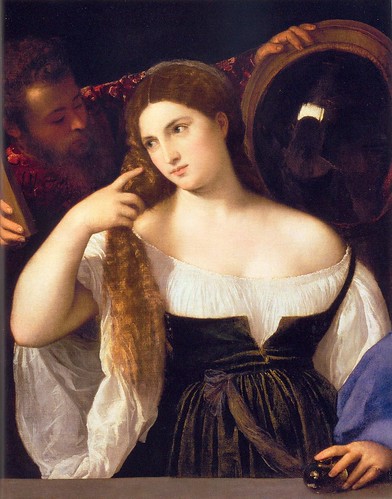
So, basically everyone was hypocrites at the time. So who painted the good stuff? Well, there’s Titian. Yeah, “Titian”. Well, fine, his real name was Tiziano Vecelli or Tiziano Vecellio (1485 – 1576), and he was like this leader of the 16th-century Venetian school of the Italian Renaissance. The man Titian isn’t important though. He’s just good with colors and composition. You can tell how influential these old painters simply by how popular their works are (Duh). Here’s two of his more notable accomplishments:

And yes, this pic is known as the Venus of Urbino. According to art historians, “the ‘frankness’ of Venus' expression has often been noted, seeing as she stares straight at the viewer, unconcerned with her nudity. In her right hand she holds a posy of flowers whilst her left covers her vulva, provocatively placed in the centre of the composition. In the near background a dog, symbolizing fidelity, is asleep.”
The Gutenberg site also states that “…in his 1880 travelogue A Tramp Abroad, Mark Twain called the this painting "the foulest, the vilest, the obscenest picture the world possesses". He proposed that "it was painted for a bagnio and it was probably refused because it was a trifle too strong', adding humorously that "in truth, it is a trifle too strong for any place but a public art gallery". Funny guy.
From the Gutenberg, who can explain this a lot better than I can: “In 1482, Lorenzo de Medici purchased a lyre which Leonardo had fashioned in the shape of a horse's skull, intending to send it to Ludovico Sforza ofMil an. Leonardo asked to personally deliver the gift, and when he did, Sforza persuaded him to remain in Milan, where he painted his famous mural The Last Supper on the wall of a monastery.

Leonardo da Vinci took full advantage of having all these wealthy bastards who wanted good art, traveling all over during his career, “..leaving every place he visited awed by his presence... His notebooks, recently published, contain ideas for such inventions as the scaling ladder, rotating bridge, submarine, armored vehicle, and helicopter, none of which were built until decades or centuries later.”
As an aside, I really wanted to buy this Da Vinci hardbound book, but it pisses me off that these books cost more than my basic salary. F**k that!
Pope Leo X preferred the work of the painter Raphael, however, and Leonardo moved on, becoming court painter to Francis I of France, where he remained until his death in 1519. In addition to The Last Supper, Leonardo's best known work is the Mona Lisa, the most famous portrait ever painted. Many of da Vinci's greatest ideas remained just that, and he recorded his plans for future inventions and his notes on life around him in notebooks that have given historians insight into the true extent of his genius.”
Pope Julius II wanted Michaelangelo to create a tomb for him. A grand monument with over forty statue. It took Mike eight months to select the stone. The Pope eventually got impatient and cancelled the project.
Later, Michaelangelo, inspired by the belief that he had a divine calling, traveled to Rome, where, at age 23, he carved the Pieta, a bust of the Virgin Mary, bringing him instant fame. When he returned to Florence in 1501, he was commissioned to sculpt the Hebrew King David, just as Donatello had. Michaelangelo's David became the symbol of Florence's prospering artists, and remains there today.
I always dreamed of taking a tour around Europe. Oh well. I guess I should just make plans to visit this recreation in the game Second Life.
In 1508, Michaelangelo began his work decorating the walls and ceiling of the Sistine Chapel in Rome. The project was arduous and time-consuming, and when he finished he had painted over 300 human figures. The painting of the ceiling has assumed legendary status and is considered one of the great artistic undertakings of all time.”
Now here’s Raphael, born Raffaello Santi. I typed this guy’s name on google, and that Raffaello name kept popping up. Now I know. Thank you, ignorance! Anyway, like what Gutenberg said, “Raff was the leading painter of the Renaissance. In 1508, Pope Julius II summoned him to Rome to decorate the papal apartments in the Vatican. The most widely known of the series of murals and frescoes he painted is the School of Athens, which depicts an imaginary assembly of famous philosophers.
The Harmonist of the Renaissance is his title. And this harmony extended to a blending of thought, form, and expression, heightening or modifying every element until they ran together with such rhythm that it could not be seen where one left off and another began. He was the very opposite of Michael Angelo.
Raphael maintained the favor of the Julius II and his successor Leo X, and thus painted for papal commissions all his life. He was widely renowned as the greatest painter of his age, and considered so important by his contemporaries that when he died at the premature age of 37 he was buried in the Pantheon.”
Finally, we have good ol’ Andrea del Sarto (1486-1531) who was some Florentine pure and simple. He did a lot of madonnas and altar-pieces, and wasn’t religious himself. Gutensberg described this man more as a painter more than a pietist, and was called by his townsmen "the faultless painter." So he was as regards the technical features of his art.

Gutenberg sez’ “He was influenced by other painters to some extent. Masaccio, Ghirlandajo, and Michaelangelo were his models in drawing; Leonardo and Bartolommeo in contours; while in warmth of color, brush-work, atmospheric and landscape effects he was quite by himself. He had a large number of pupils and followers, but most of them deserted him later on to follow Michelangelo.” Yeah. That sucks.
So that' High Renaissance for ya'. It's badly research, woefully incomplete, but that's because you have to pay forty bucks for all the good essays. Will Baroque be next?
"Hey medmapguy, just what the hell were you thinking? What is this Classicism crap? This isn't going to be grade-school level art discussion, will it?! Just... what part of 'modern visual culture' involves the works of the masters from a bygone era!?"
Everything! The works of the masters such as Da Vinci, Michelangelo, Rembrandt, Carravagio, Goya, and many more are what inspired a generation of concept artists working in the creative industry today! your sarcasm, I know you can easily search this stuff in a gazillion other websites, but I honestly learn more by typing my actual learnings on this blog, get it?
Its food for thought, people. I honestly can't tell what's baroque to a High Renaissance to a Post-Impressionism. I certainly don't plan to cover all these periods - just the very basics of those that I keep hearing about.
 A classic look? What the f**k is that supposed to mean?
All I know is the Dark Ages gave birth to the Renaissance!
Renaissance, the most fertile of all artistic eras. The time when Italy emerged as cultural leader of Europe. It was the creative hub / cultural leader in all of Europe. This era lasted from the 15th and 16th century, and introduced the world to classicism and naturalism.
 Sandro Boticelli, the guy who painted that Birth of Venus pic.
"The Mystical Nativity"
This was a time where there was a great upsurge of energy and belief in the human potential. Unlike the last period which sorta sucked. Renaissance art celebrated humanity and the visible world, abandoning the more spiritual approach of the Middle Ages.
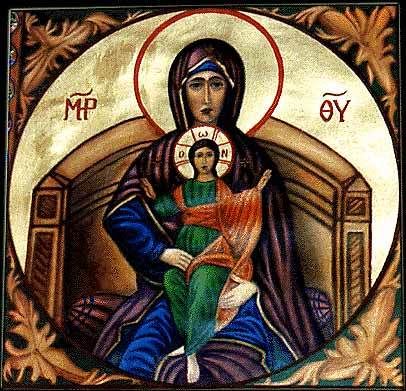 A lot of Middle Age art looked like this. And featured the same cast. Cool.
 Sandro Boticelli, La historia de Nastagio degli Onesti
The Rebirth of Antiquity became a new standard. Classical subjects and styles were adopted. A "rediscovery" of ancient techniques in architecture, building and sculpture developed the overall aesthetic. What the hell does that mean..?
 Classicism is the art movement founded on aesthetic attitudes based on the art, literature and culture of ancient Greece and Rome. (Painting above by Andrea Mantegna (1431-1506, I think!)
The Medicis, the big bosses of Italy composed of merchants and bankers, were patrons of the arts. They commissioned and required painters who could paint detailed and decorative work in brilliant colors. Sandro Boticelli (1445-1510), whose art can be seen here, is distinct in its firm outline, rich colors, and distinctive figures.
 The Adoration of the Magi by Boticelli, featured the Medicis, with their swaggering self absorbed poses, making curious contrast with the tenderly depicted figures of the Madonna and Child. Nice. Can you see those bastards?
 Another Sandro Boticelli classic. Nice coloring. Really tight. He's better than me... (Shut up)
 This is a battle scene depicted supposedly by Piero della Francesca.
 What came after this whole Renaissance bit was something even cooler. High Renaissance! This ones the winner, producing such artists as Michaelangelo, Raphael, and that geezer Leonardo Da Vinci. I think I'll delve into this in the near future since I feel I may boring the Void™ to death. Thanks to my good ol' World Book collection, and "Tree of Knowledge" binder encyclopedia. I finally found a use for that rotting thing!
At least I know now where to find more inspiration! Though it still doesn't give me the right to say crap when I visit real life art galleries.
Art Gallery Guide: Hey, who are you?
Medmapguy: M-my name is Chr--
Art Gallery Guide: Guard, get this vagrant out of the premises this instant.
But that won't happen. Anyway - since the Renaissance era doesn't have any cool videos, why not watch this animation brought to you by the awesome tool known as "Toon Boom". The film is by MathChoq, an animation student with an interesting... creative mind.


